

Third Part on Controversial Practices within the National Assembly
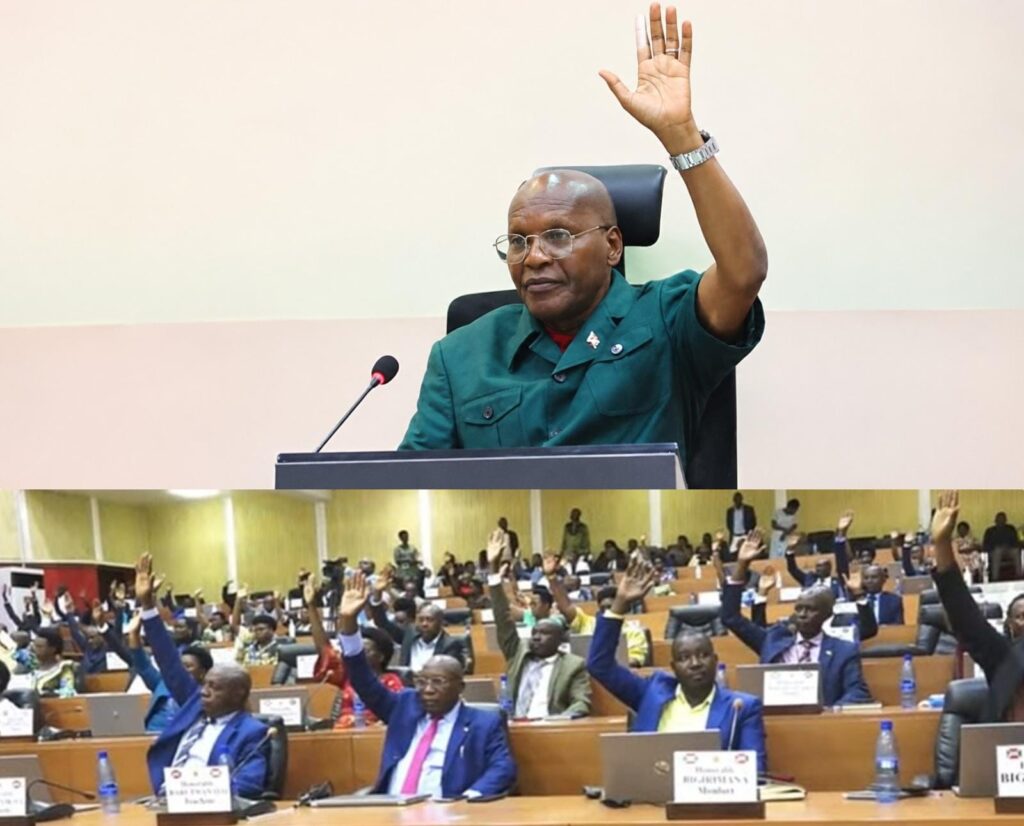
Why does the President of the National Assembly, Daniel Gélase NDABIRABE, appear to be progressively placing this republican institution under the influence of a restricted circle of close associates, with a particularly strong presence of individuals originating from the same region?
What is the real purpose behind such an approach? What are its underlying motivations? And above all, how can it be explained that strategic positions within the administration of the National Assembly are repeatedly entrusted to individuals presented as originating from one and the same province?
As announced in the previous parts, we are continuing our work of raising concerns and denouncing practices which, within the National Assembly, raise serious questions regarding the governance of the institution, transparency in the management of public responsibilities, and respect for the principle of equality among citizens.
In the first part, we highlighted the appointment of Daniel Gélase NDABIRABE’s own child, still a student, to a particular position within his administrative entourage, including responsibilities related to his personal administration and logistical affairs.
In the second part, we also addressed the reported intention to bring his former wife, with whom he has a child, into the National Assembly in order to assign her responsibilities within the institution. Following numerous reservations and warnings that were reportedly raised, the initiative was eventually abandoned.
Taken individually, each of these cases could be presented as a specific administrative decision. However, when considered collectively and placed in the broader context of the appointments examined today, they appear to point to a pattern that deserves the closest scrutiny.
A republican institution must never be transformed into the personal, family, clan-based, or regional property of an individual.
Yet the facts observed give the impression of an attempt to build, around the President of the National Assembly, an administrative apparatus based primarily on individuals regarded as close, loyal, and sufficiently committed to his interests to facilitate the implementation of his decisions.
Should this trend be confirmed, it would represent a particularly serious institutional deviation.
AN INFLUENCE THAT RAISES SERIOUS QUESTIONS
Despite the dissatisfaction and concerns reportedly circulating within the institution, Daniel Gélase NDABIRABE appears to be pursuing his course of action with a level of confidence that cannot fail to raise questions.
Where does he derive such authority to impose his choices?
What political mechanisms enable him to exercise such broad discretion in the distribution of responsibilities?
Does he benefit from particular protection or support because of his position within the leadership structures of the ruling party, notably within the Council of Elders of the CNDD-FDD?
These questions cannot simply be dismissed. They become even more legitimate when one examines the manner in which responsibilities appear to be progressively redistributed within the administration of the National Assembly.
An institution of such importance cannot operate in opacity, nor can it be subjected to personal, family, or regional networks of influence.
IS THE NATIONAL ASSEMBLY BECOMING THE “ASSEMBLY OF BUTANYERERA”?
On this 14 August 2026, we draw public attention to a situation that deserves clear and public explanations: the particularly high concentration of responsibilities among individuals presented as originating from Butanyerera, the province from which the President of the National Assembly also originates.
According to the information available to us, a significant proportion of the most important administrative and technical positions is currently occupied by individuals originating from the same province.
Even more troubling, some officials from other regions are reportedly being removed from their positions or deprived of responsibilities they previously held, while the positions concerned are subsequently entrusted to individuals from Butanyerera.
If these elements are confirmed, they raise a fundamental question that those responsible for the institution must be prepared to answer:
Is the National Assembly still the Assembly of the Republic of Burundi, representing the entire nation, or are we witnessing the gradual emergence of an “Assembly of Butanyerera” placed under the influence of a single man?
A national institution cannot be administered as private property, let alone as a domain reserved for people from a particular regional background.
OFFICIALS PRESENTED AS ORIGINATING FROM BUTANYERERA
According to the information gathered, the following individuals, presented as originating from Butanyerera, currently hold important positions within the administration of the National Assembly:
-
NIYINDORERA Fidélité — Secretary General
-
BIZUMUREMYI Fabien — Deputy Secretary General
-
SABUSHIMIKE Gorgon — Head of Protocol
-
KWIZERA Charité — Director of Administration and Finance (DAF), recently replaced; the circumstances and reasons for this decision will be addressed in a forthcoming part
-
IYAMPEZAGIYE Solange — Principal Adviser for Social Affairs, presented as the wife of the Governor of Butanyerera, Victor SEGASAGO
-
MACUMI Liévin — Principal Legal Adviser
-
MUCO Guillaume — Principal Political and Diplomatic Adviser
-
HARERIMANA Jeanne Chantal — Principal Adviser for Parliamentary Committees
-
NDIKUMANA Pauline — Principal Adviser for the Parliamentary Bureau/Questure
-
NIYONZIMA Nicolas — Principal Security Adviser, former colonel
-
NININAHAZWE Alfred — Legislative Director
-
MANIRAMBONA Josélyne — Head of Logistics
-
MWIZIGIRWA Aimable — Private Secretary
-
Annick — Deputy Private Secretary
-
AYINKA Yves — Head of Human Resources
-
NZEYIMANA David — Head of Information Technology
-
HAVYARIMANA Libert — Head of Transport and Vehicle Services
The concentration of such a significant number of important responsibilities among individuals from the same regional area cannot simply be dismissed as an administrative coincidence without serious explanations being provided.
THE REPUBLIC CANNOT BE GOVERNED ACCORDING TO CLAN-BASED LOGIC
Burundi is a republic. Its institutions belong to the Nation, not to those who temporarily occupy positions of authority.
The National Assembly must be administered according to transparent and objective criteria: competence, integrity, experience, merit, probity, equal treatment, and the public interest.
Provincial origin, family ties, personal proximity, or loyalty to a political leader must never become decisive criteria for access to public responsibilities.
The facts we are reporting therefore raise serious questions regarding respect for the principles of equality, administrative neutrality, transparency, and good governance.
We call for full transparency regarding the procedures that led to these appointments, transfers, and dismissals.
The competent authorities must be able to explain clearly and document the criteria applied to each decision, and demonstrate that those criteria are applied without discrimination to all citizens.
The National Assembly is neither a family inheritance, nor a regional fiefdom, nor the personal property of its President.
It is an institution of the Republic.
It belongs to the Burundian people.
Any attempt to transform a republican institution into a personal, family, clan-based, or regional instrument would constitute a serious deviation that our organization refuses to normalize or accept.
We strongly condemn any practice that could exclude citizens from access to public responsibilities because of their regional origin or because they lack personal proximity to those who hold power.
We therefore call for an urgent and transparent reassessment of these practices, as well as a return to the principles of merit, fairness, accountability, and good governance.
For one question remains, and it deserves a clear and unequivocal public answer:
Who does the National Assembly truly belong to: the Burundian people, the Republic, or Daniel Gélase NDABIRABE?
END OF THE THIRD PART
This concludes the third part of our series examining practices and institutional dysfunctions that raise profound concerns within the National Assembly.
In the coming parts, we will continue our work of investigation and public scrutiny by bringing forward additional elements which, in our view, deserve to be brought to the attention of the public.
Our approach remains guided by one essential principle: transparency in the management of public institutions, equality among citizens, and the defense of the public interest.