

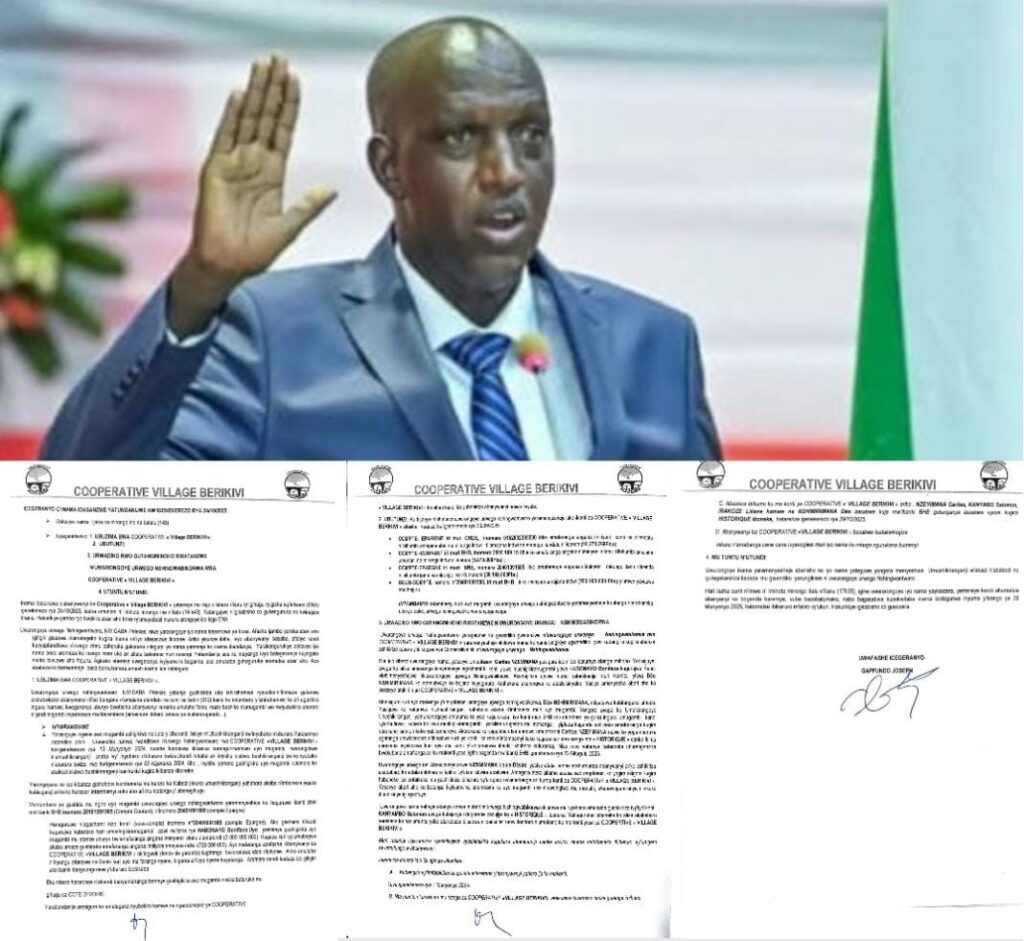
Employees of the Ministry of Labour and Public Service are denouncing prolonged salary deductions made to finance a cooperative created by former minister Venuste MUYABAGA, who was recently reinstated to his position. This situation raises serious concerns about financial management, internal governance, and accountability within the cooperative.
🔶 Origin of the Project and Financial Structure
The former minister initiated a cooperative known as VILLAGE BERIKIVI, bringing together all employees of the ministry. The stated objective was to facilitate access to social housing for staff, thereby creating a form of collective social capital.
To finance the project, the cooperative opened a bank account at CRDB Bank. Employees were subjected to mandatory salary deductions, intended to serve as a bank guarantee (“collateral/aval”) for future housing construction. These deductions effectively constituted a forced mobilization of wage-based capital to finance a real estate investment project.
However, the centralized and opaque management of the funds by Venuste MUYABAGA quickly generated tensions. He maintained exclusive control over the financial flows, transferring funds between accounts without transparency, financial disclosure, or consultation with cooperative members. This raises serious questions regarding fiduciary responsibility, governance failures, and moral hazard in the management of the cooperative.
🔶 Project Opacity and Investment Risks
Members began questioning the actual progress of the project. They were informed that land had allegedly been acquired in Kabezi (Bujumbura Province) for the construction of the housing units, yet they were never allowed to visit or verify the site.
This information asymmetry significantly eroded trust among contributors, increasing perceptions of opacity and amplifying fears of capital loss and investment mismanagement.
🔶 Reinstatement of Venuste MUYABAGA and Escalation of Tensions
Following Venuste MUYABAGA’s reinstatement on 05/08/2025, the situation further deteriorated. Employees reported that members of the management committee began demanding additional contributions, while parts of the cooperative’s funds appeared to be mismanaged or possibly diverted.
According to banking sources, approximately 700 million Burundian francs (FBu) had already been deposited for the project. The absence of transparent accounting, financial reporting, and oversight heightened concerns about embezzlement, asset dissipation, and financial malpractice.
🔶 Extraordinary General Assembly
In response, cooperative members convened an extraordinary general assembly on 24/10/2025 at the ENA school, according to minutes obtained.
Venuste MUYABAGA declined to attend the meeting, despite being the head of the cooperative’s management committee. Participants voiced serious concerns regarding fund security and allocation, noting the lack of internal controls and the opacity surrounding the cooperative’s bank accounts.
The assembly adopted the following resolutions:
● Immediate suspension of all salary deductions;
● Prohibition on any committee member requesting further contributions;
● A demand for full clarification of the cooperative’s financial situation, including an internal audit, by 29/10/2025.
🔶 Letter to the Authorities
On 30/10/2025, employees submitted a confidential letter to the CTI officer within the ministry, formally requesting the suspension of salary deductions for the VILLAGE BERIKIVI cooperative and the establishment of full financial transparency.
🔶 Restitution of Funds and Economic Recommendations
Although salary deductions have been suspended, employees are now demanding the restitution of all funds already deducted. They are also calling on Venuste MUYABAGA to appear publicly to clarify the situation and provide guarantees regarding responsible and transparent fund management, fearing that the money may have been irreversibly misused or diverted.
This case highlights the urgent need for effective cooperative governance, strict accounting procedures, independent financial audits, and external oversight to safeguard employee investments and protect their economic and financial rights.